
Audience Research
AI, Deepfakes & the New Age of Disney
“Does using AI and deepfakes cost Disney the trust its brand is built on?”
A mixed-methods survey of 46 young adults on how Disney's use of AI and deepfake technology shapes their trust in a brand built on human storytelling. The headline: audiences aren't rejecting AI outright — but using it without telling them is where the trust breaks.
Report
The Full Report
- Executive summary
- Purpose & research questions
- Method
- Key findings
- Conclusions & recommendations
- Limitations
- Sources
- The survey instrument
The Brief
Why It Mattered
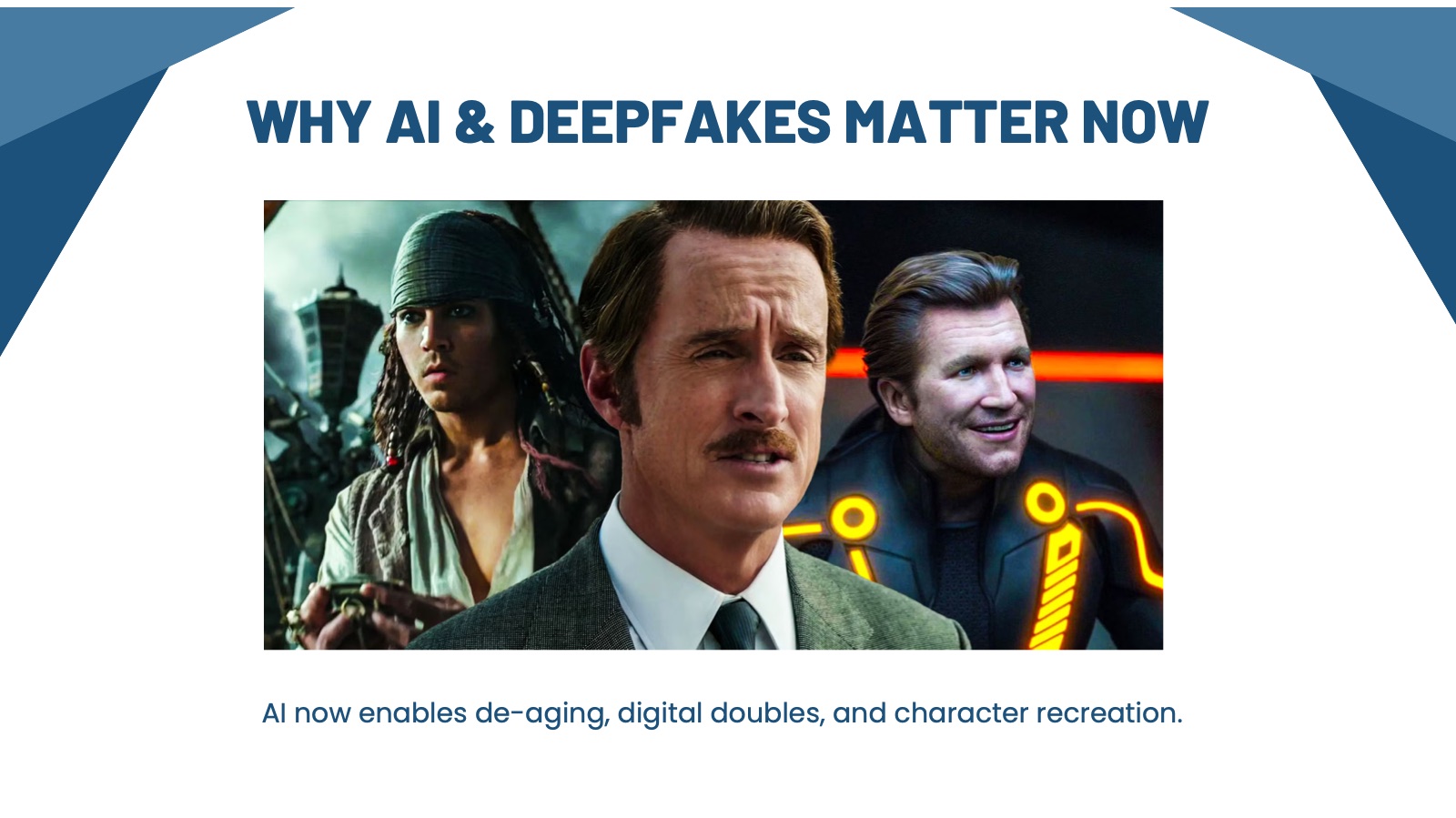
AI now makes de-aging, digital doubles, and the recreation of beloved characters cheap and accessible, and it's showing up across film, television, and advertising. For most studios that's a production question. For Disney — a brand whose entire value rests on emotion, nostalgia, and human storytelling — it's a reputation question.
The Goal
To measure how Disney's target audience responds to the company's use of AI and deepfakes in storytelling and advertising: what it does to trust, which uses feel acceptable versus unethical, and what audiences expect from Disney on disclosure and consent.
Research Design
What We Set Out to Answer
Research Questions
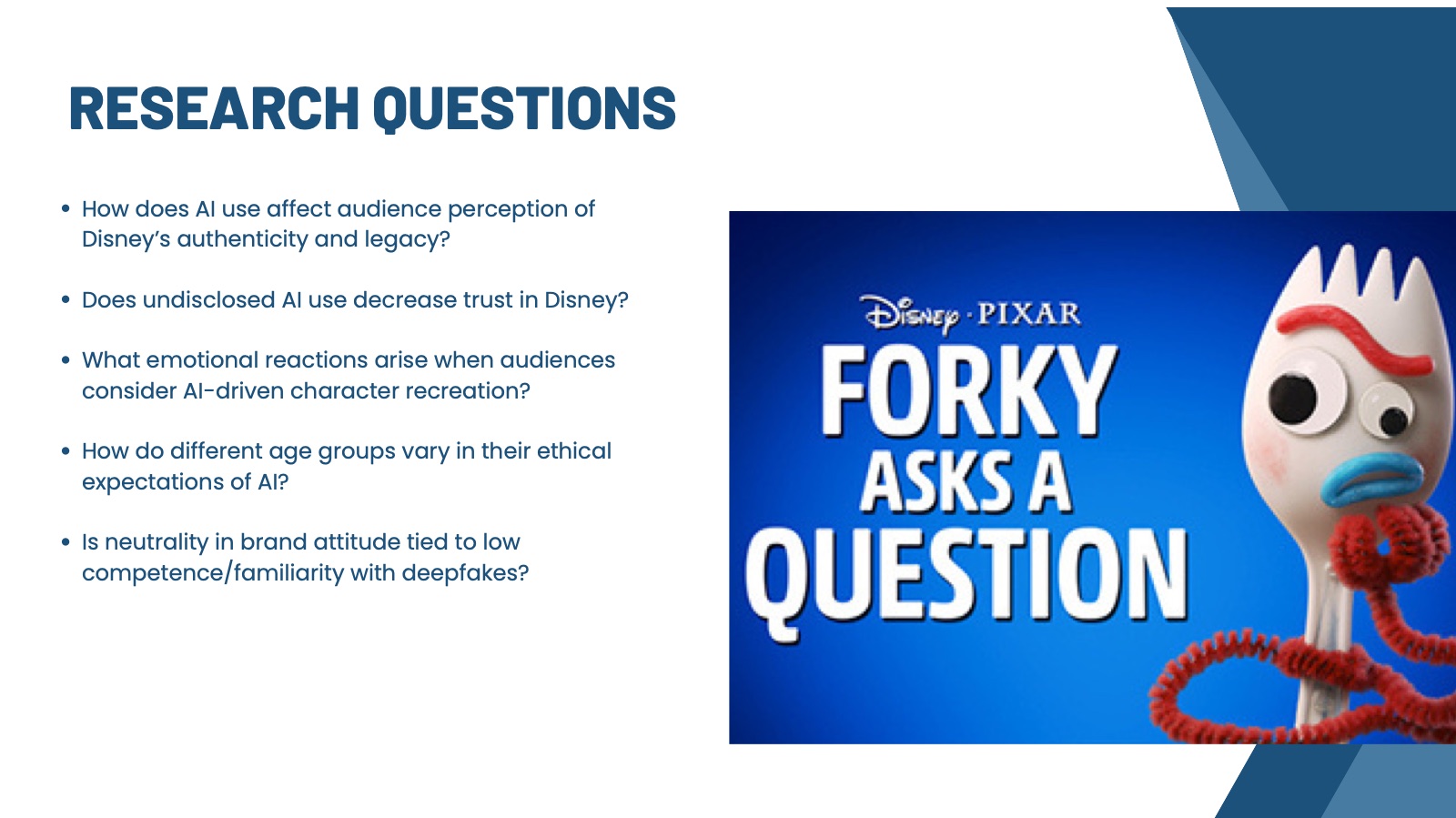
- RQ1 How familiar are audiences with deepfake technology, and can they identify one when shown an example?
- RQ2 Are reactions to AI and deepfakes in Disney media positive, negative, or neutral?
- RQ3 To what extent should Disney disclose AI use — especially with legacy characters or deceased actors?
- RQ4 Where do audiences draw the ethical line on consent, authenticity, and manipulation?
- RQ5 How does AI use affect trust in Disney's reputation for authentic, emotionally resonant storytelling?
- RQ6 Are attitudes shaped by age, familiarity with Disney content, or prior exposure to AI media?
Hypotheses
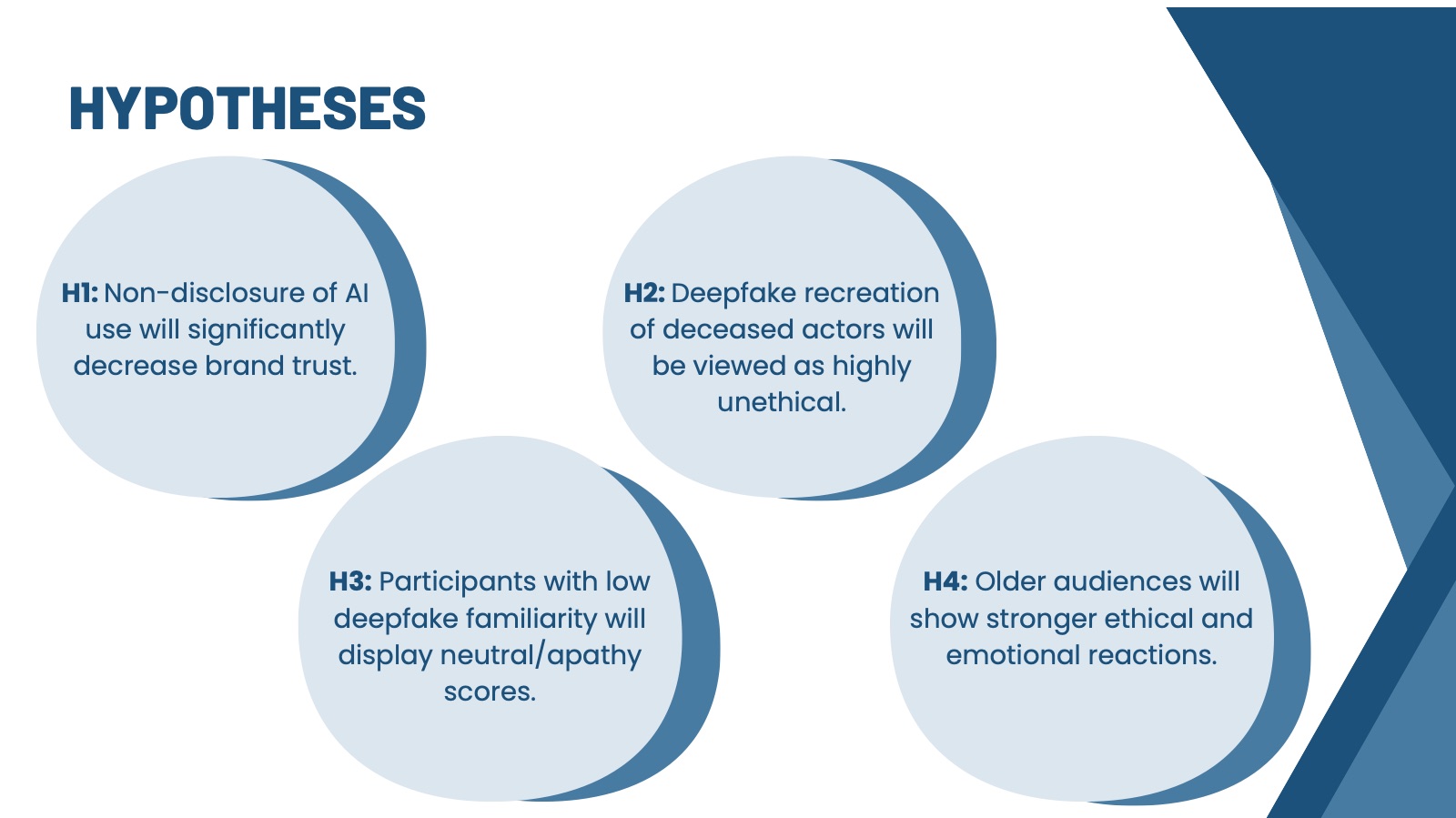
- H1 AI and deepfakes offer real creative and operational benefits, which is why they're spreading through entertainment companies like Disney.
- H2 Undisclosed deepfakes trigger negative responses around authenticity, manipulation, and ethics.
- H3 Audiences accept minor enhancements, like de-aging or background refinement, far more readily than full character replacement.
- H4 Audiences expect Disney to disclose AI use, and a lack of transparency reduces brand trust.
- H5 Younger audiences show less concern about AI than older or family-oriented viewers.
Method
How We Answered It
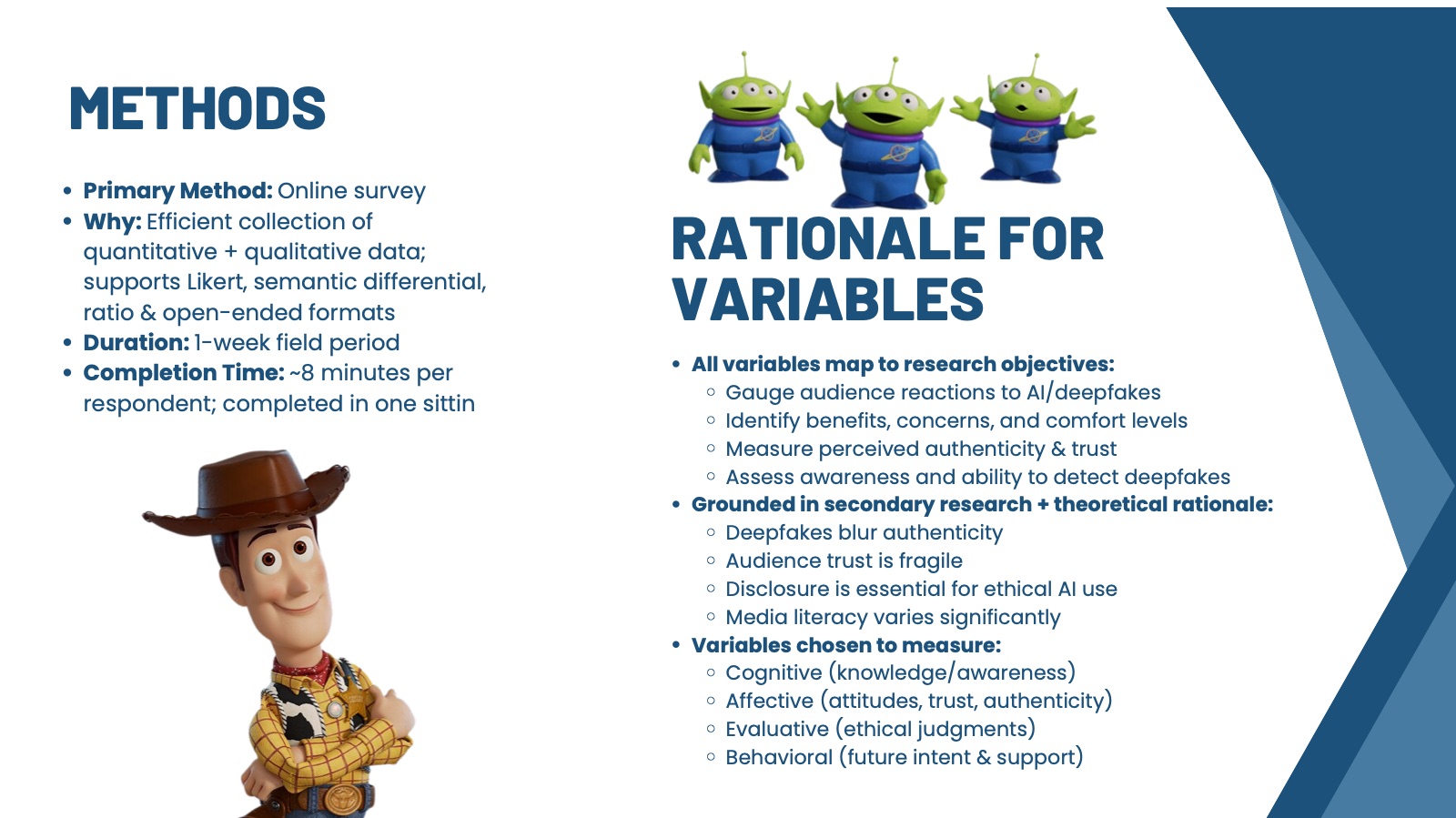
An online survey distributed by text, email, and social media, open for one week and taking about eight minutes. Respondents were given a definition of deepfakes up front to set a shared baseline, then shown a real Disney deepfake beside the unaltered actor and asked to identify it, before moving on to ethics, trust, and advertising.
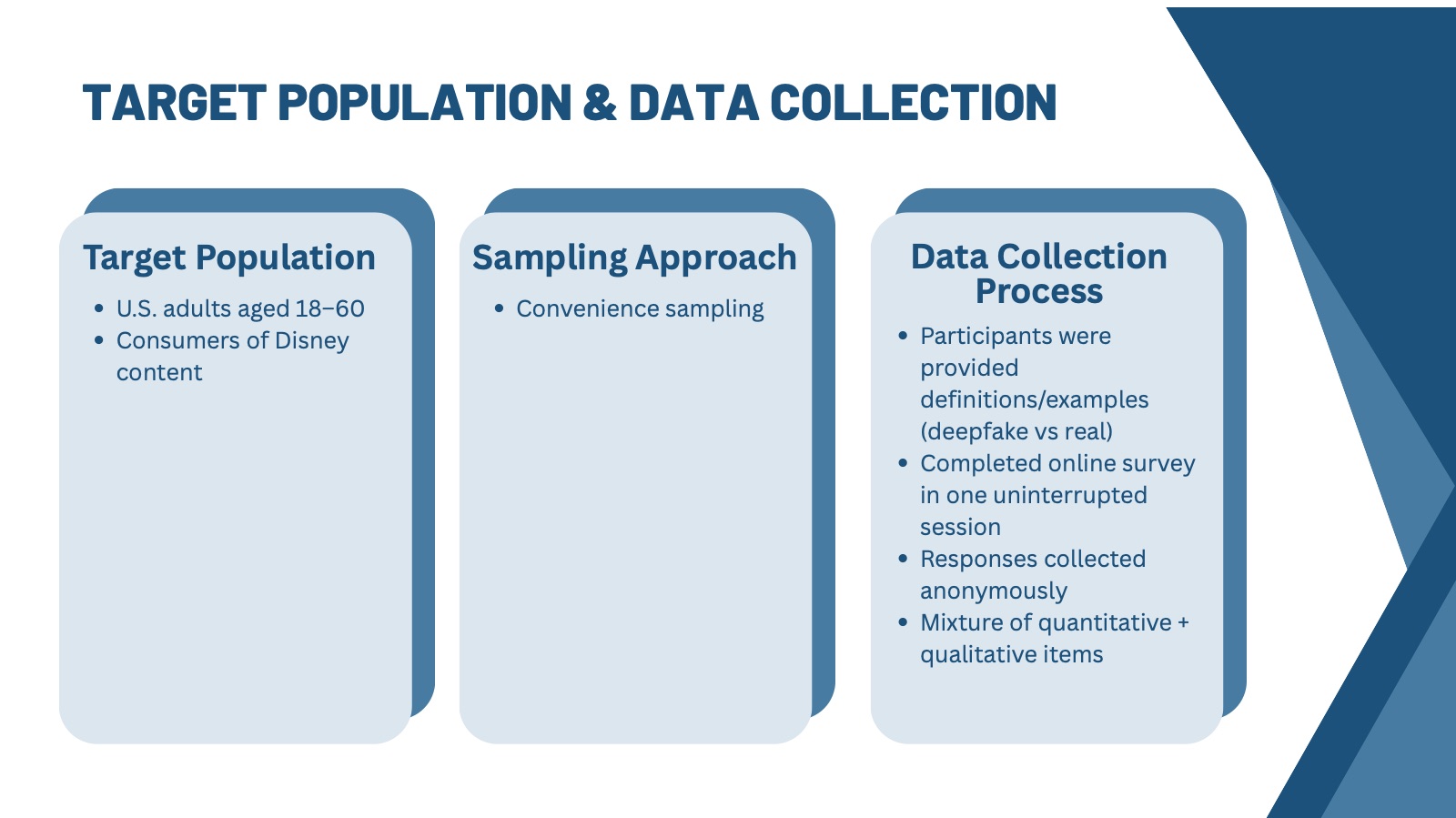
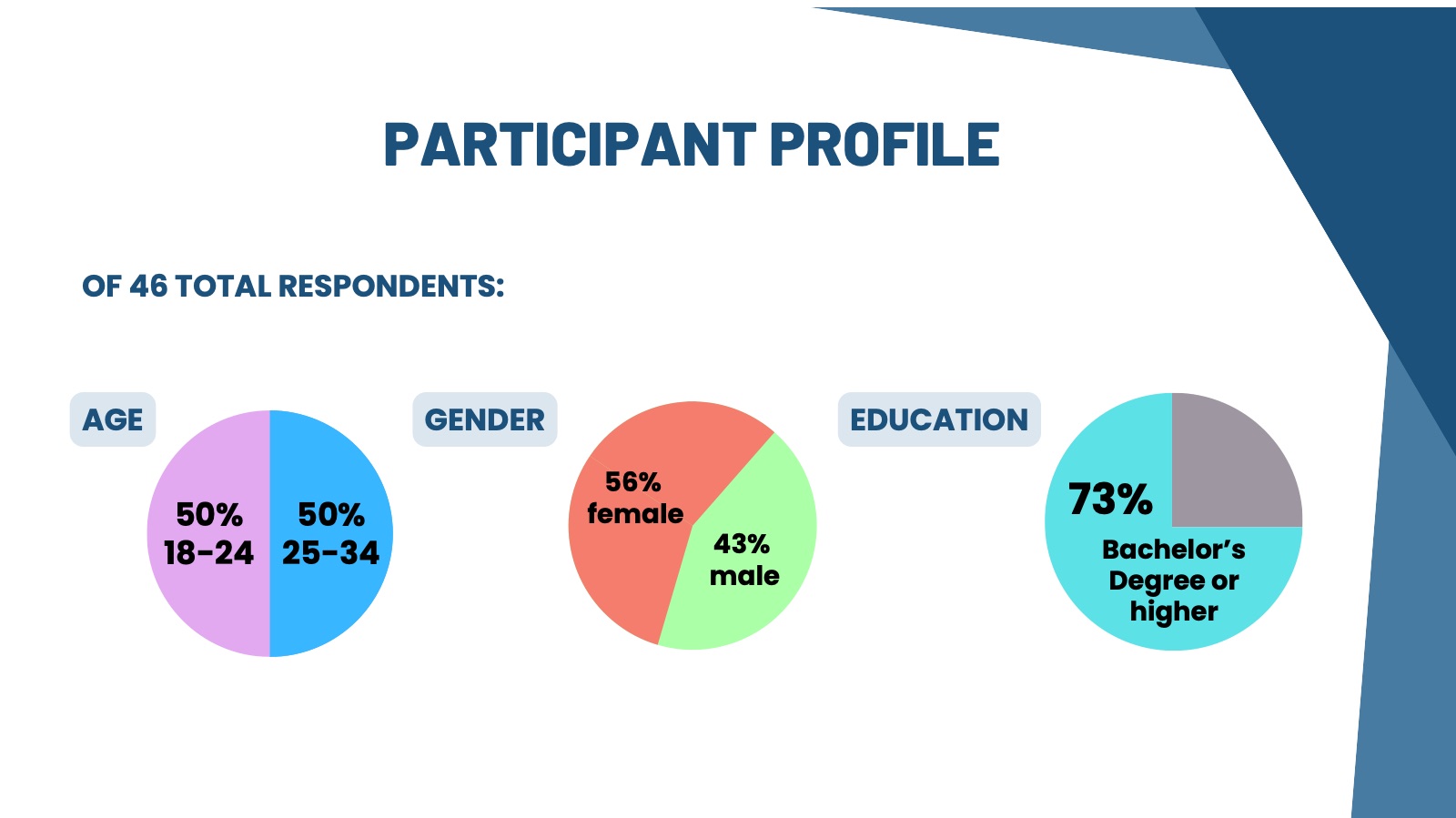
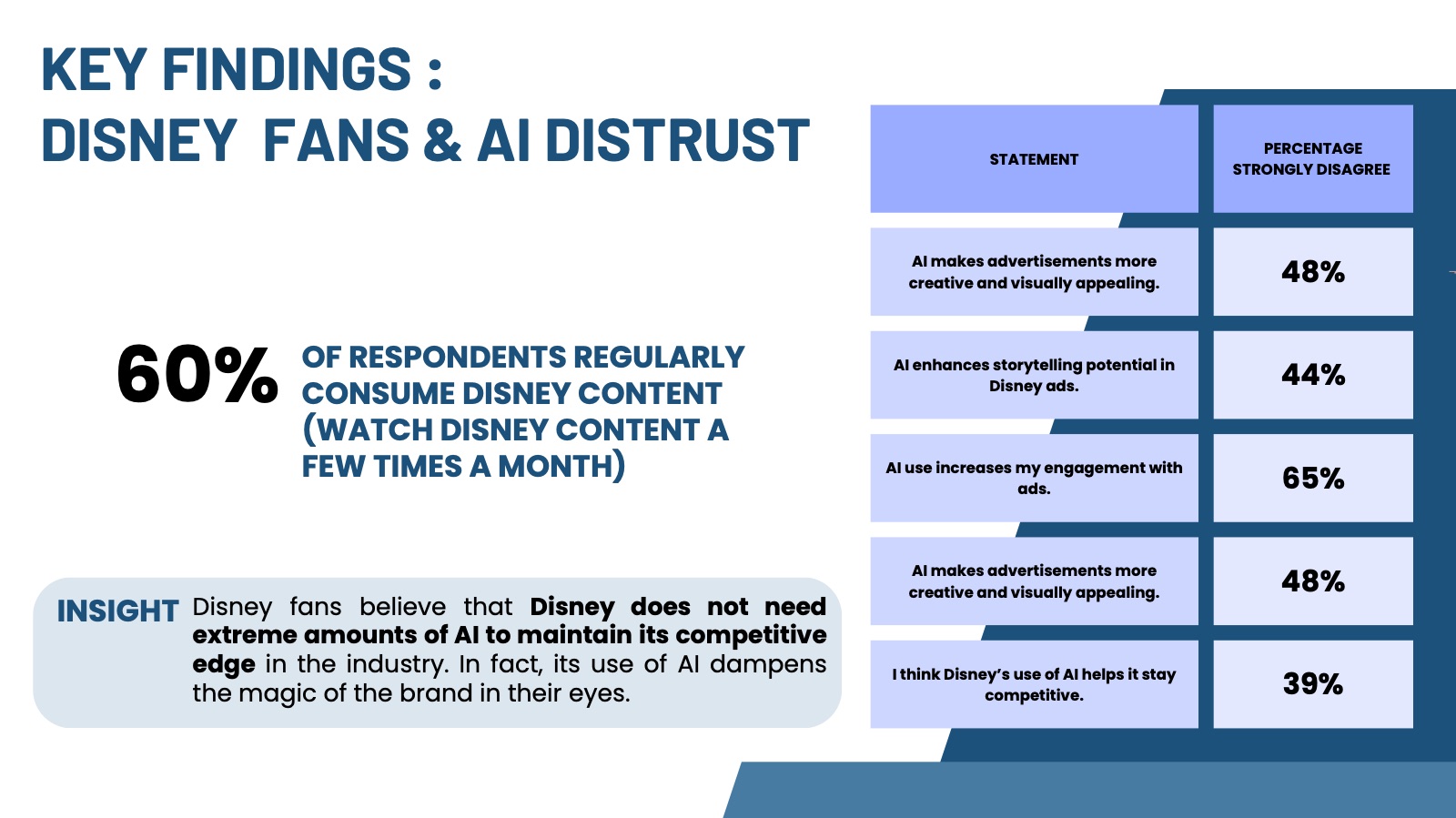
46 U.S. adults aged 18–34 who regularly consume Disney content, recruited through convenience sampling. The sample split evenly between 18–24 and 25–34; 57% identified as female, and 73% held a bachelor's degree or higher.
Question Formats
Four Measurement Dimensions
Cognitive
Knowledge and awareness of AI and deepfakes
Affective
Attitudes toward AI, including trust and authenticity
Evaluative
Ethical judgements, especially about replicating a likeness
Behavioral
Future intentions, support, and likelihood of engaging
Findings
What the Data Showed
Finding 01
Apathy tracks with low AI literacy
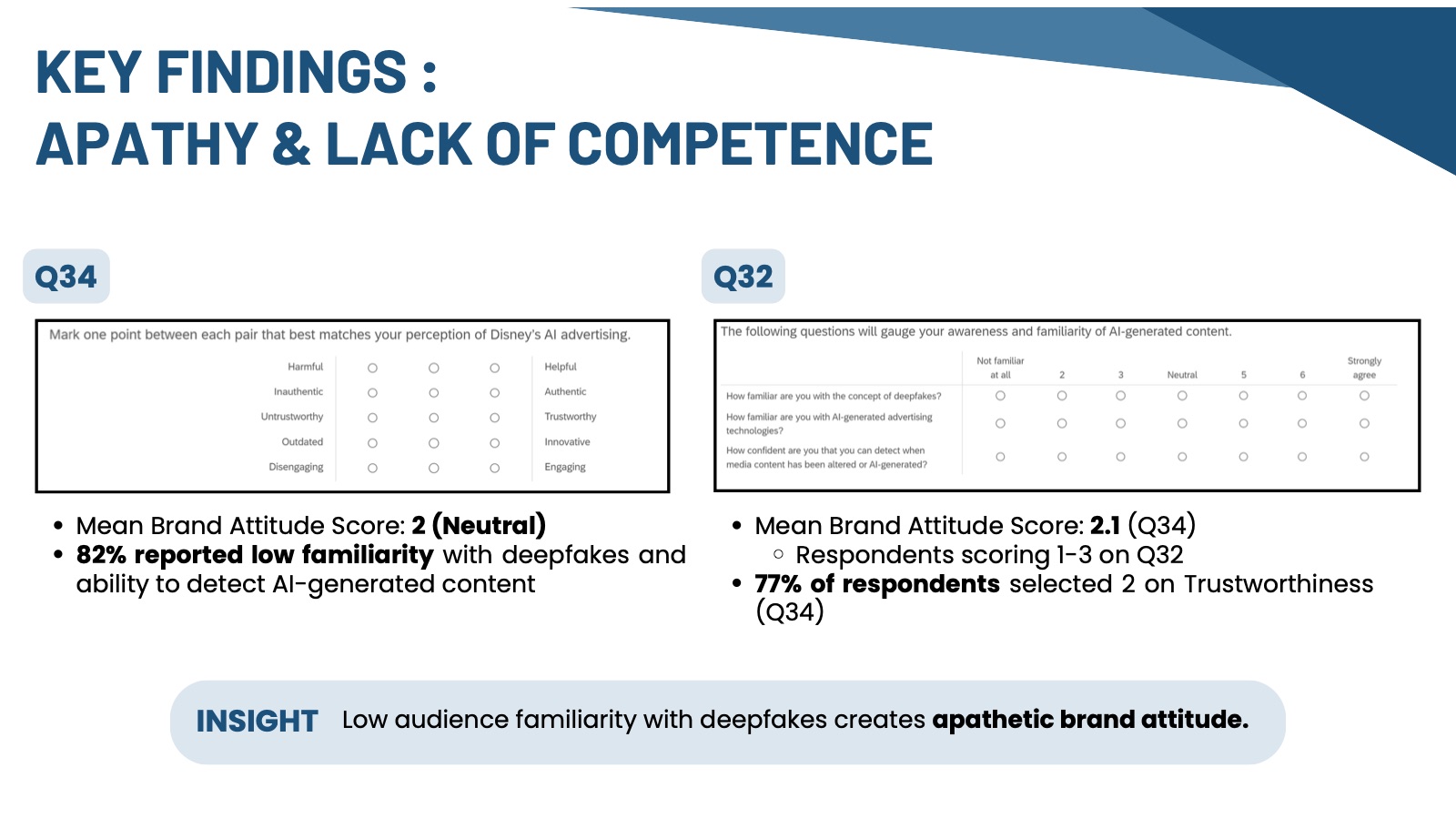
On the scales, respondents looked indifferent: the mean brand attitude score toward AI in advertising was a neutral 2, and respondents at the low-to-neutral end of that scale rated their own familiarity with AI at 2.1 — mostly unfamiliar. Low literacy was producing a flat response. But the open-ended answers told a different story, and far more emotionally — pointing to survey fatigue and an easy neutral option masking stronger feelings underneath.
“Putting talented people out of jobs.”
“Lazy, anti-art, lack of environmental awareness, cheap, and underhanded.”
View this data as a table
| Measure | Respondents | Share |
|---|---|---|
| Reported low familiarity with deepfakes and with spotting AI-generated content | 37 | 82% |
Finding 02
Non-disclosure is where trust breaks
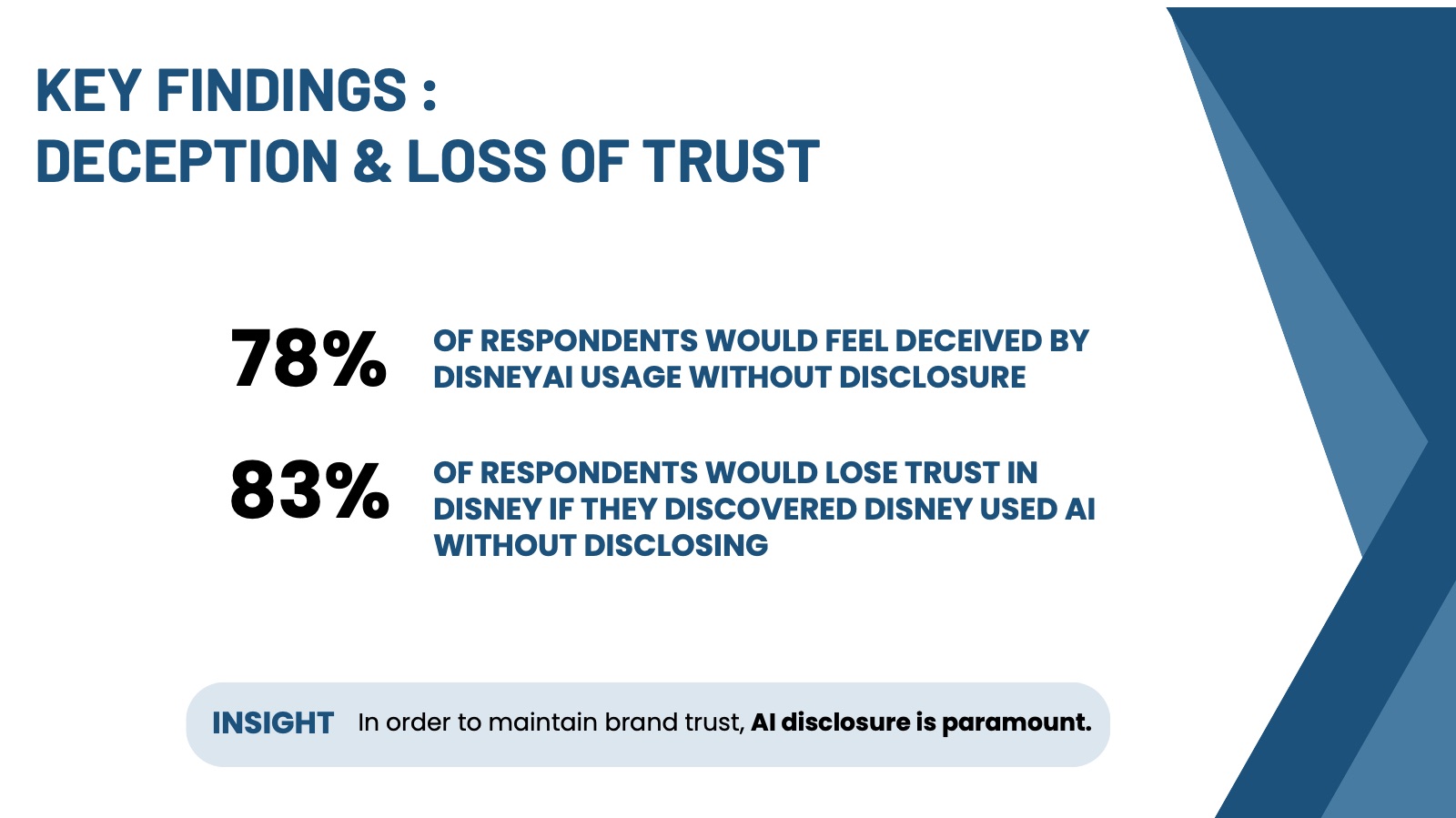
This was the clearest signal in the study. Asked whether they'd feel deceived if Disney used AI without saying so, 78% agreed; asked whether their trust would drop, 83% did. And when asked what would make them comfortable with AI-generated advertising, 30% of those who answered named clear disclosure unprompted.
“Clearly disclosed, and no employees suffer from wage loss or downsizing because of it.”
View this data as a table
| Measure | Respondents | Share |
|---|---|---|
| "If Disney used AI without disclosing it, I would feel deceived." Somewhat agreed, agreed, or strongly agreed. | 35 | 78% |
| "If I discovered AI was used without disclosure, my trust in Disney would decrease." Somewhat agreed, agreed, or strongly agreed. | 38 | 83% |
Finding 03
Ethical concern rises with age
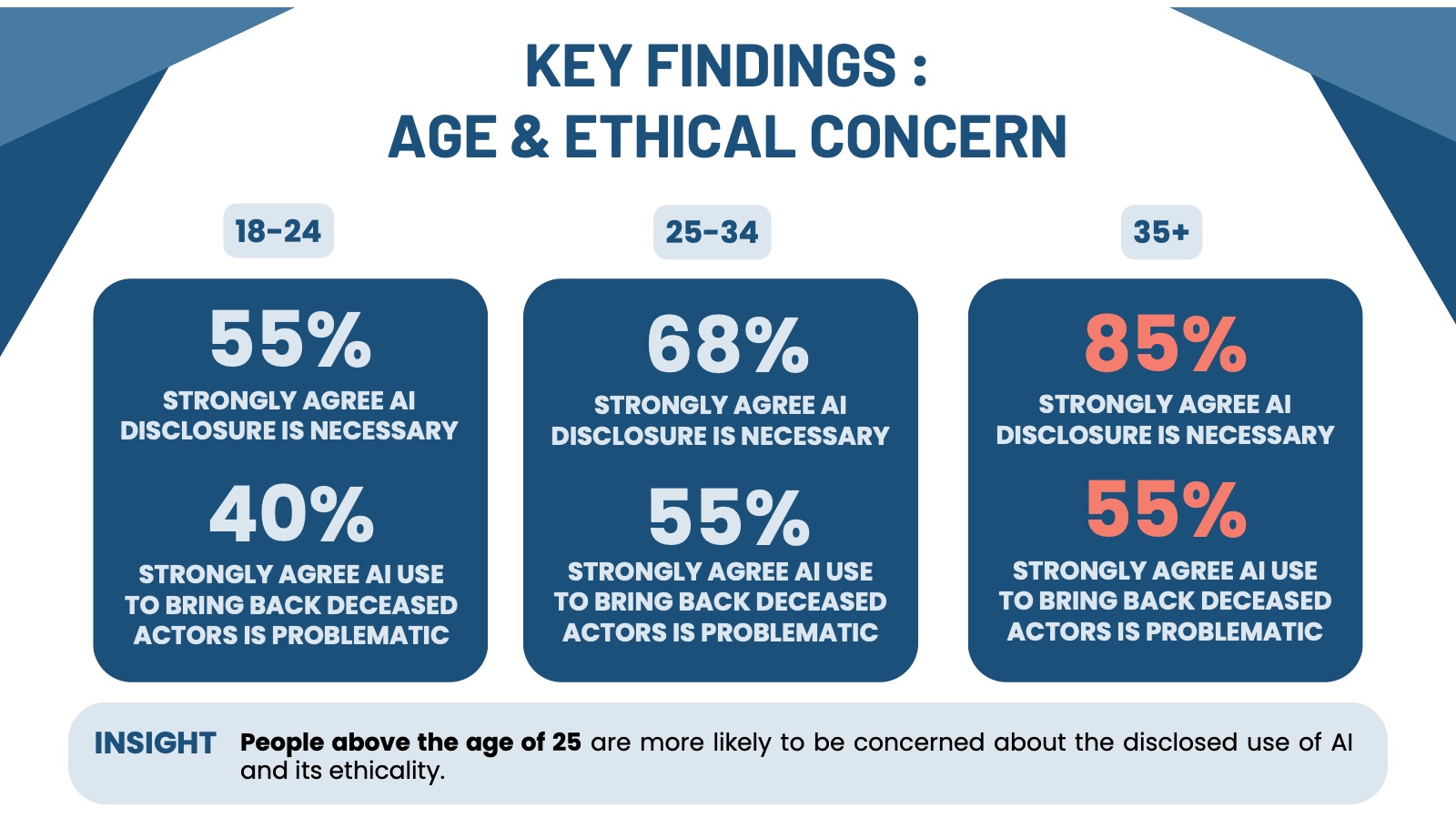
Share who strongly agreed, by age group
AI disclosure is necessary
Ages 18–24
Ages 25–34
Using AI to revive deceased actors is a problem
Ages 18–24
Ages 25–34
Cross-tabulating by age showed concern climbing between the two groups on both disclosure and the digital revival of deceased actors — suggesting that as Disney's audience gets older and more nostalgic, the reputational stakes of AI get higher, not lower.
“Just enough to make the end product more engaging, but no less human.”
View this data as a table
| Measure | Group | Respondents | Share |
|---|---|---|---|
| Strongly agreed that AI disclosure is necessary | Ages 18–24 | 12 | 55% |
| Strongly agreed that AI disclosure is necessary | Ages 25–34 | 15 | 68% |
| Strongly agreed that using AI to revive deceased actors is problematic | Ages 18–24 | 9 | 40% |
| Strongly agreed that using AI to revive deceased actors is problematic | Ages 25–34 | 12 | 55% |
Recommendations
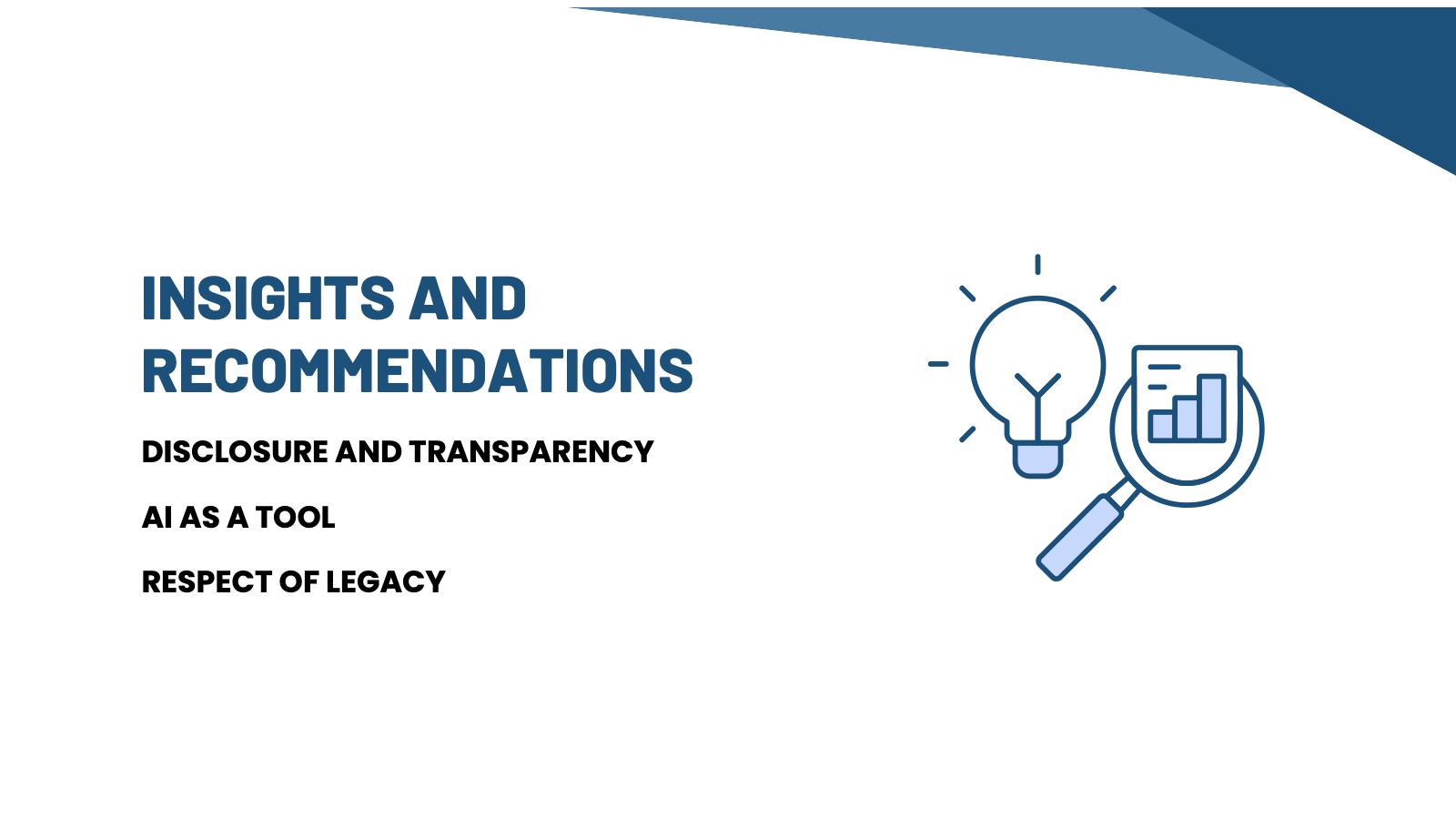
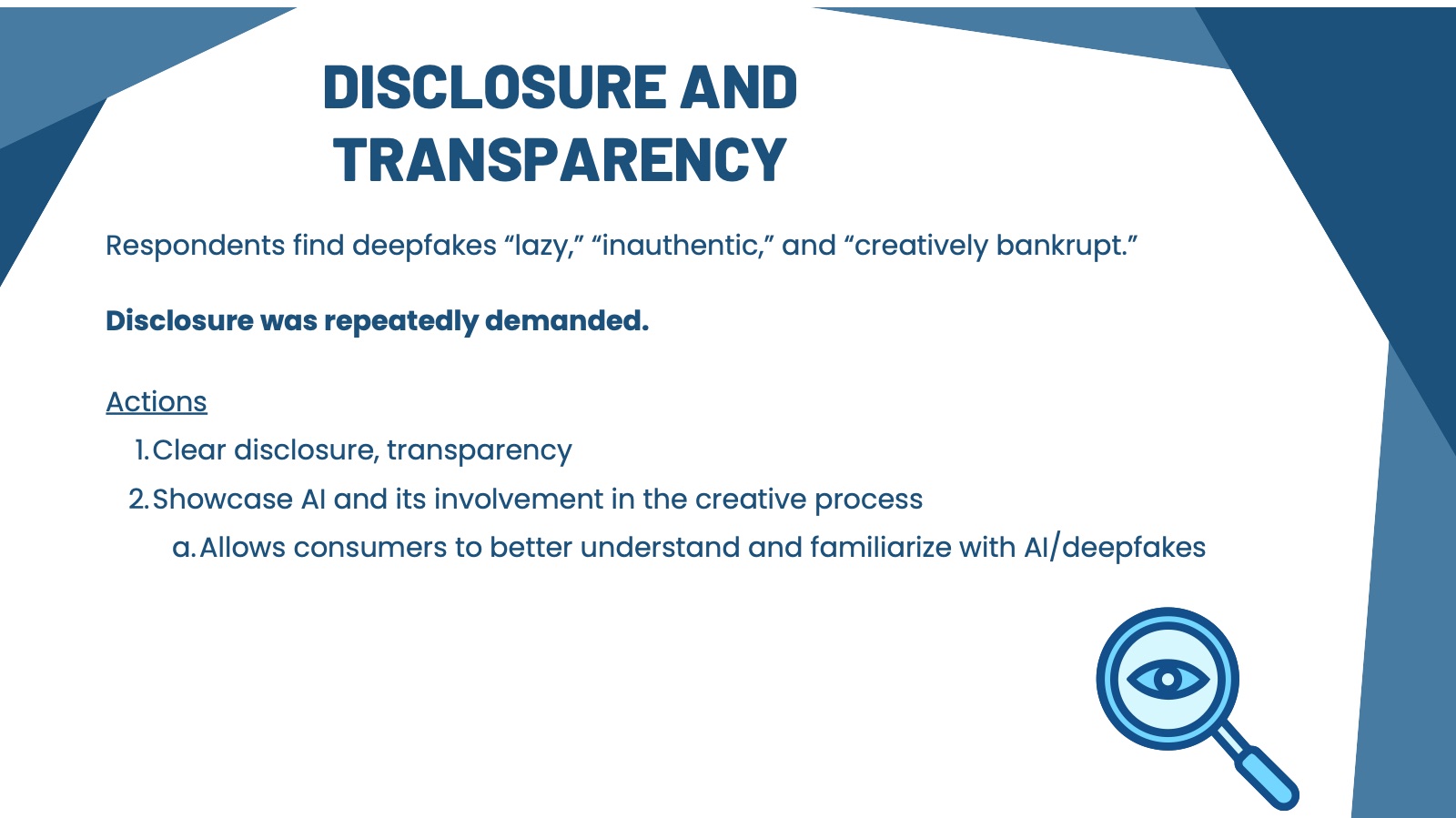
Disclose, and explain
Be upfront when AI or deepfakes are used, and show how they support the storytelling rather than replace it. Transparency builds the AI literacy that was missing, and removes the sense of being quietly deceived.
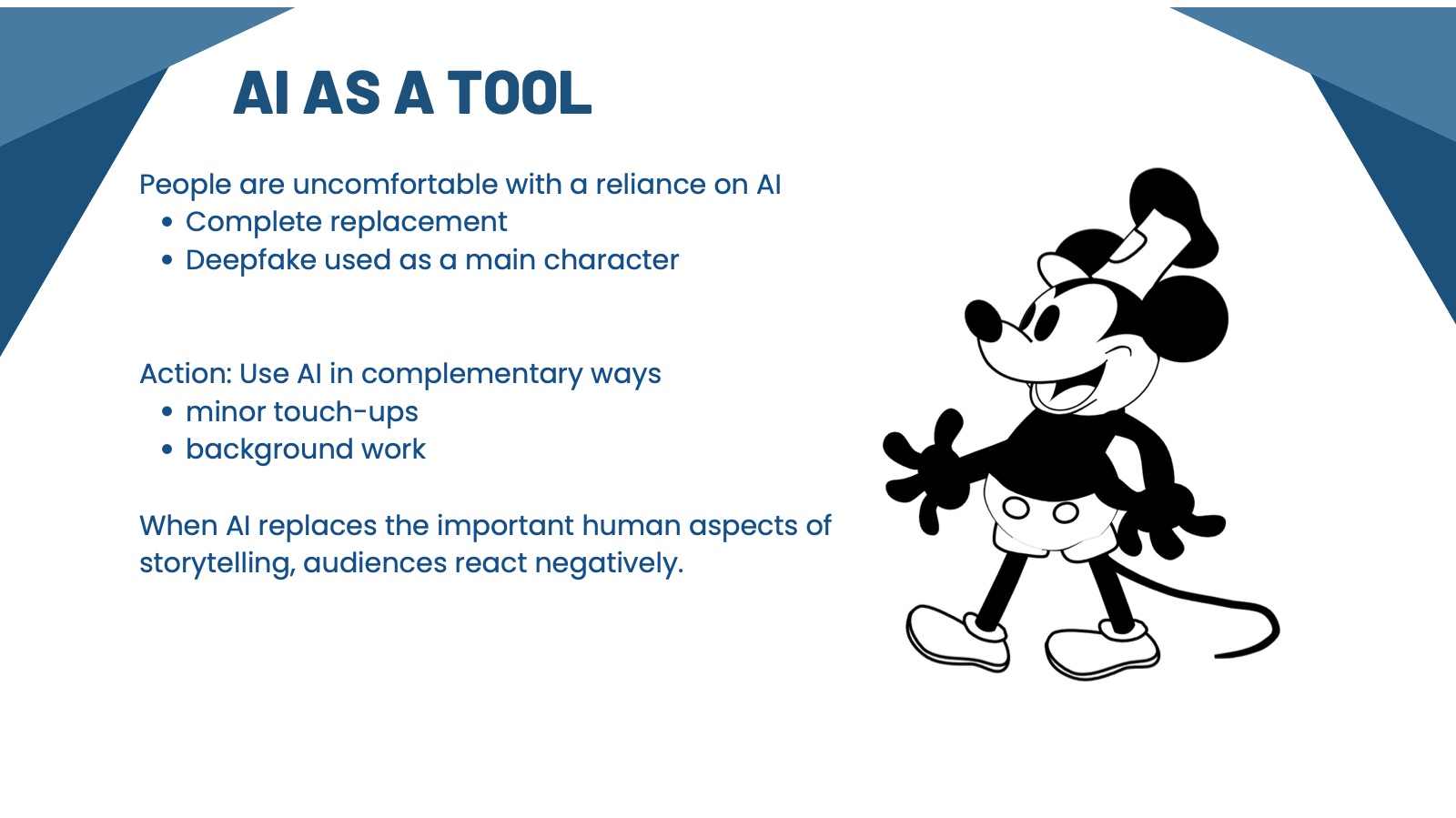
Use AI as a tool, not a replacement
Keep AI to minor, practical work — touch-ups, de-aging, localization. Replacing an actor, or making a deepfake a main character, read to respondents as "creatively bankrupt."
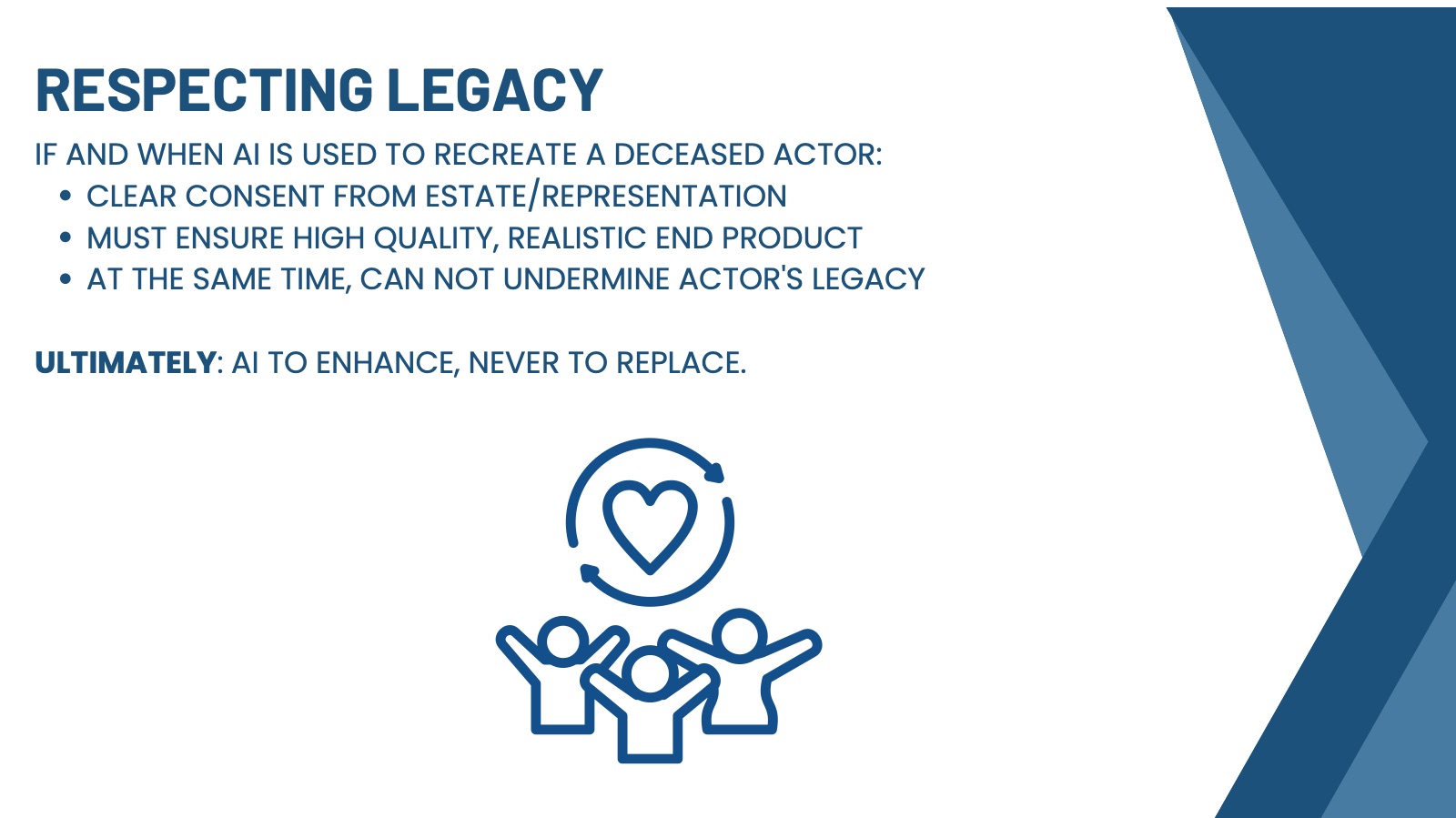
Respect the legacy
When recreating a deceased actor, secure consent from the estate, share that consent with audiences, and hold the result to a high quality bar to avoid an uncanny, disrespectful end product.
Limitations
What This Study Can't Claim
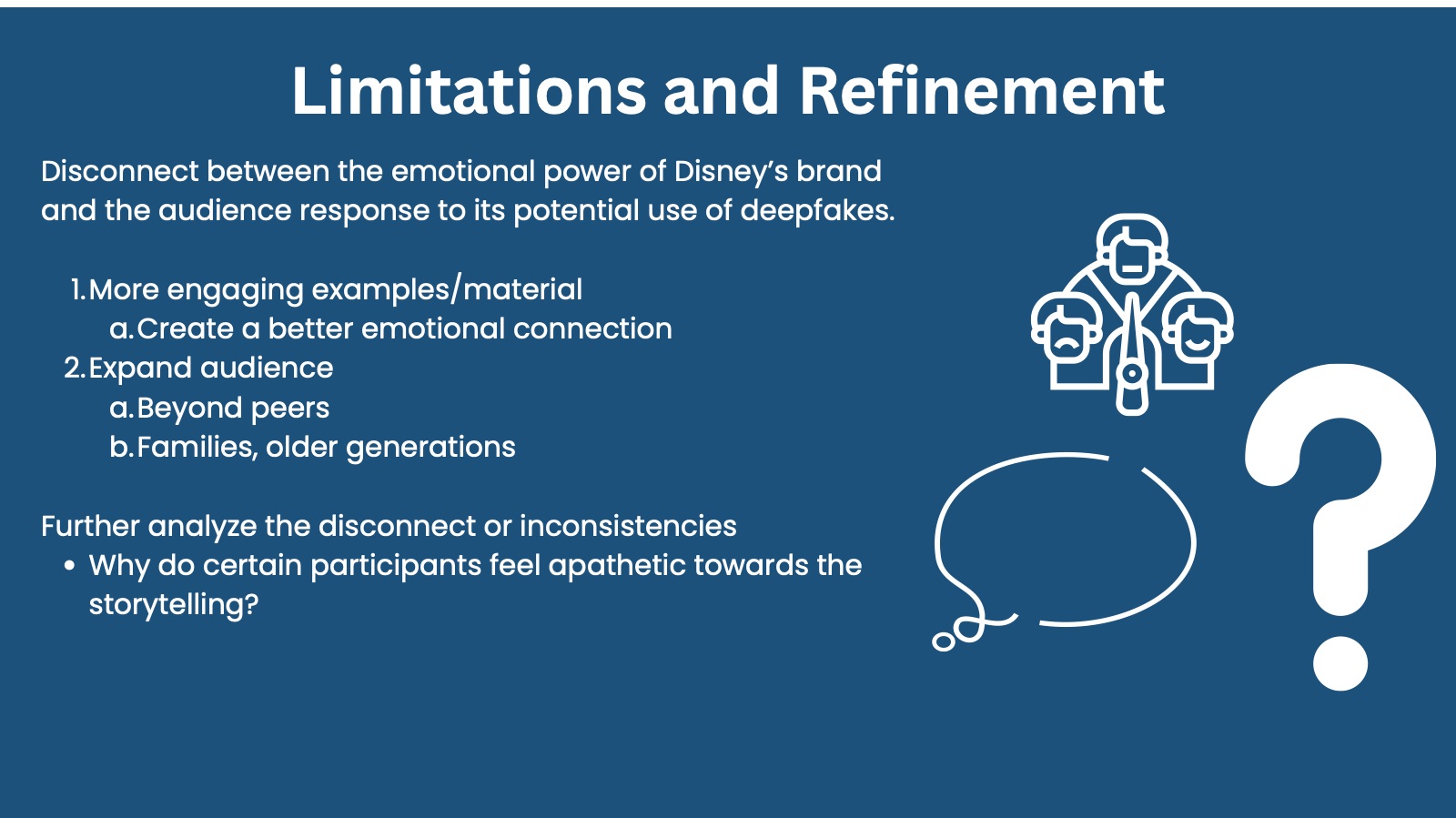
- Convenience sampling drew mostly USC students and the team's extended networks, so the results aren't generalizable.
- The media examples didn't produce much emotional activation — more moving examples would test the brand connection more fully.
- The reasons behind indifferent responses weren't captured, which would have clarified whether the neutrality was genuine or an artifact of survey fatigue.
A team project. Researched and presented with Allyson Nicholas, Evan Lee, and Billy Rand. My contribution was survey design, data analysis & writing.